Research Talk – Chris Sollars: The Neighbors
This Research Talk features Professor of Geography Justin Mankin and PhD Candidate in Ecology, Evolution, Environment, & Society Joseph Savage.
Mankin's research on climate variability and change is motivated by the risks global warming poses to ecosystems and people. Using observations alongside empirical and process-based models, his efforts are prospective—focused constraining uncertainties in future climate impacts—and retrospective—attributing the climate impacts that have already occured. He is committed to ensuring that climate data are a public good and his hope is that his science can help inform climate adaptation and decision-making. In his previous career, Dr. Mankin worked overseas as an intelligence officer.
PhD candidate in Ecology, Evolution, Environment, & Society, Joseph Savage works with Jonathan Winter in the Geography Department as a part of the Applied Hydroclimatology Group to study tick populations and the impact of climate change. Savage's interests center on disease and community ecology, and use theoretical techniques to study these complex systems. Their current research focuses on understanding and forecasting how climate and landscape changes are driving the population dynamics and pathogen prevalence of Ixodes scapularis--the blacklegged tick--which is responsible for spreading Lyme disease in the Northeast.
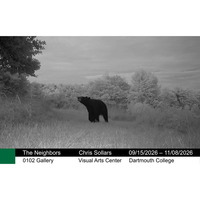
This programming accompanies a faculty exhibition by Associate Professor of Studio Art Chris Sollars, The Neighbors, a new body of work inspired by coexistence and inquiry.
Set in rural Vermont, The Neighbors is a multimedia video installation about the non-human inhabitants of the lands around the artist’s home. After over two decades living in San Francisco, California, Sollars moved to Vermont in the fall of 2024. To get to know his new home and neighbors, he has spent the past two years interacting with his surroundings through slow listening and observation, learning them spatially and temporally. This intentional gathering of information has taken the form of diaristic snapshots taken throughout the seasons, field recordings, the collection of discarded nests and materials, and the placement of wildlife cameras in the open woodland edges of his home, which neighbors a land trust, a national forest, and the Appalachian Trail.
The Neighbors is on view from Sept. 15 – Nov. 8, 2026.