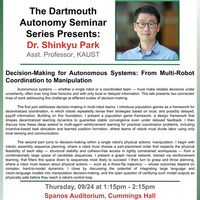
Dartmouth Autonomy Seminar Series: Dr. Shinkyu Park
Dr. Shinkyu Park, Assistant Professor at KAUST presenting on "Decision-Making for Autonomous Systems: From Multi-Robot Coordination to Manipulation"
Abstract: Autonomous systems — whether a single robot or a coordinated team — must make reliable decisions under uncertainty, often over long time horizons and with only local or delayed information. This talk presents two connected lines of work addressing this challenge at different scales of decision-making.
The first part addresses decision-making in multi-robot teams. I introduce population games as a framework for decentralized coordination, in which robots repeatedly revise their strategies based on local, and possibly delayed, payoff information. Building on this foundation, I present a population game framework, a design framework that shapes decentralized learning dynamics to guarantee stable convergence even under delayed feedback. I then discuss how these ideas extend to multi-agent reinforcement learning for practical coordination problems, including incentive-based task allocation and learned coalition formation, where teams of robots must divide labor using only local sensing and communication.
The second part turns to decision-making within a single robot's physical actions: manipulation. I begin with robotic assembly sequence planning, where a robot must choose a part-placement order that respects the physical feasibility of each step — structural stability and collision-free access in tightly constrained workspaces — from a combinatorially large space of candidate sequences. I present a graph neural network, trained via reinforcement learning, that filters this space down to sequences most likely to succeed. I then turn to grasp and throw planning, where a robot must reason about physical actions — such as a throw-flip trajectory — whose outcomes depend on complex, hard-to-model dynamics. I close by discussing the potential of integrating large language and vision-language models into manipulation decision-making, and the open question of certifying such model outputs as physically safe before they reach a robot's control loop.
The Dartmouth Autonomy Seminars explore how common principles of autonomy link fields such as robotics, economics, and cognition. It brings together academia and industry to discuss autonomous systems. More information can be found here: https://sites.dartmouth.edu/das/